

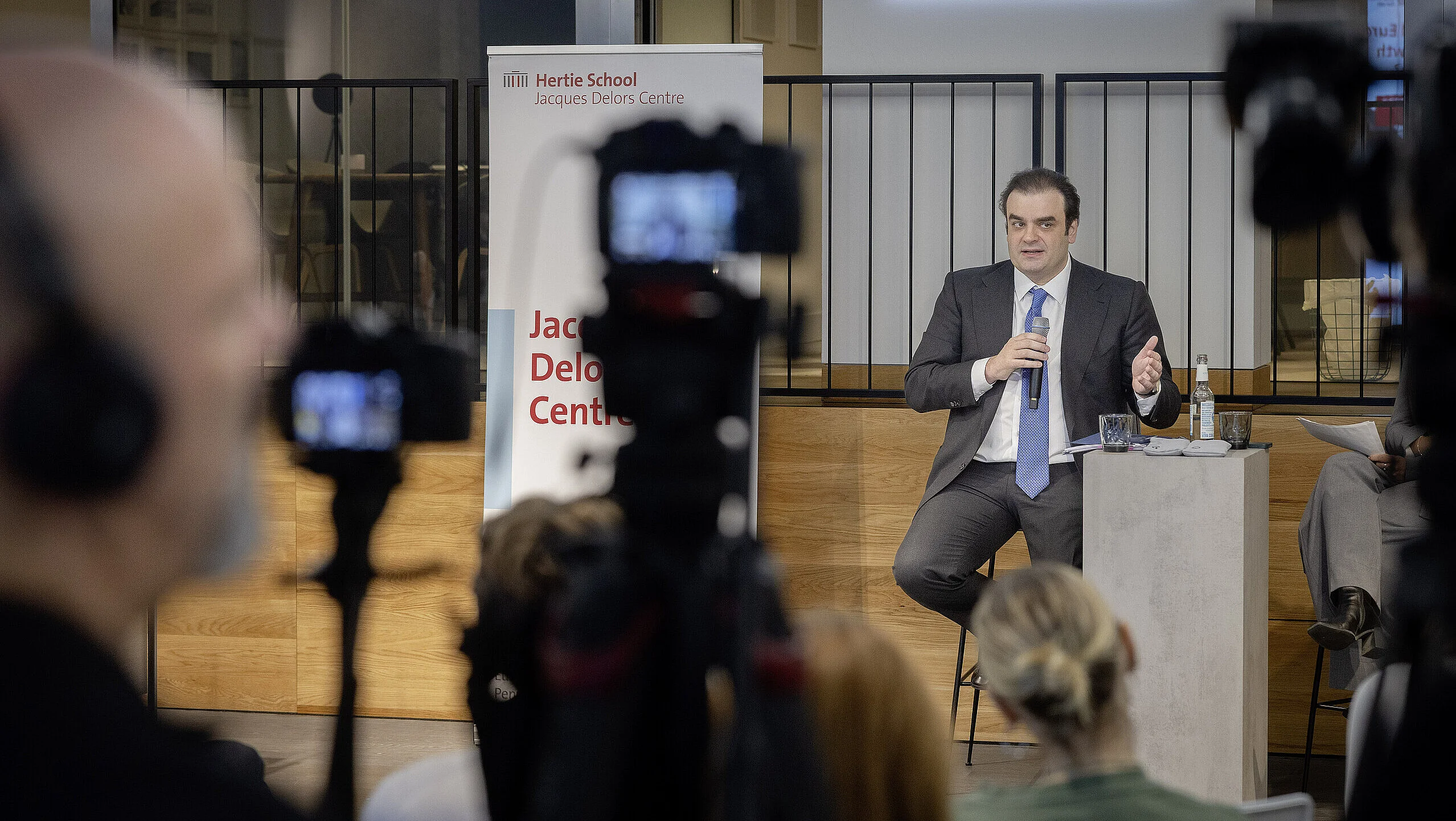
On 15 September 2026, the Jacques Delors Centre welcomed Kyriakos Pierrakakis, President of the Eurogroup and Minister of Economy and Finance of Greece, for a conversation on the outlook of future growth and the choices Europe is currently facing. The discussion was moderated by Thu Nguyen, Acting Co-Director of the Jacques Delors Centre, followed by a Q&A session with the audience.
Standing united against fragmentation in Europe
A central theme of the discussion was Europe's struggle to achieve the scale that is needed to stay globally competitive. President Pierrakakis underlined that fragmentation into relatively small, national markets continues to hold back growth across the continent. He argued that with changing geopolitical and economic realities, Europe increasingly needs common solutions: “Every country has national concerns, national interests – but right now, the changes that we see in externalities and in context have changed the calculus of Europe.” When asked about the best way to confront the barriers to European scale, President Pierrakakis called for a united Europe where policymakers push for progress in many different facets of deeper economic integration.
He named the telecom industry as an example of high fragmentation where “every country acted on its own” despite it being an area of clear European technological advantage. Thus, in President Pierrakakis’ view, Europe should build the institutional frameworks needed to make better use of its existing technological advantages.
From private savings to productive investment
The discussion also focused on Europe's investment challenge. Addressing the 1.2 trillion euros annual investment gap that Europe is currently facing, Pierrakakis pointed to challenges in obtaining investments from the private sector: “The core point of interest is the fact that we have significant savings which do not translate into investment.”
He did acknowledge “overall movement”, such as progress made on the Savings and Investments Union, and the fact that “the Irish Presidency [of the Council of the European Union] is doing a very good job”. Yet he also underlined that Europe must do more to create the conditions for investment and growth, referring to the difficulties that startups face when wanting to grow and scale up in Europe.
Making every euro count
The EU budget and the Multiannual Financial Framework (MFF) were also part of the discussion. President Pierrakakis called for an ambitious approach focused on expanding Europe's productive capacity: “This debate is typically perceived as a zero-sum game. We should try to think in positive sums; to achieve many things at once.”
When talking about renewed sovereign debt risks in the euro area, Pierrakakis showed himself to be “concerned but not alarmed”, applauding the broad spectrum of institutions that were founded after the sovereign debt crisis and that have strengthened Europe's resilience. However, he warned that these could not substitute national strategies.
Reforms that pay off: the Greek success story
Referencing Greece’s economic transformation over the past decade, Pierrakakis closed with a hopeful message: “If there’s one inspiration to be drawn from Greece, it’s that reforms pay off”.
While acknowledging that every country faces its own challenges, he argued that successful reforms create positive feedback loops that strengthen growth and resilience over time. Europe, he concluded, should approach these challenges with a willingness to learn from one another: "We need to learn from each other by being inspired and not by being taught."
Watch a recording of the discussion below.


Photos: Vincent Mosch
